Like much of America—or perhaps more specifically, women currently hovering somewhere between 45 and 60—I’ve become obsessed with Love Story, Ryan Murphy’s new dramatization of the romance between John F. Kennedy Jr. and Carolyn Bessette-Kennedy.
Not for the plot.
Spoiler alert: they perish.
No, the real draw is something else entirely: an unexpected ache for the 1990s that I didn’t know I had.
Maybe it’s the show’s soundtrack.
Maybe it’s the fashion.
Ok—let’s be honest—it’s absolutely the music and the clothes.
The show feels like a strange and wonderful validation that the things I thought were cool in the ’90s—listening to Peter Gabriel, wearing slip dresses and distressed Levi's 517 jeans—were, in fact, cool. Not just cool, but apparently timeless.
Which brings me to what any completely normal person—especially one who may or may not have a Kennedy shrine in their home—would do next.
I went hunting for an old copy of George.
For those who remember, George Magazine was the glossy political experiment launched by John himself in the mid-90s—politics as pop culture, power dressed up with a little celebrity sheen. It was smart, stylish, and very much of its moment.
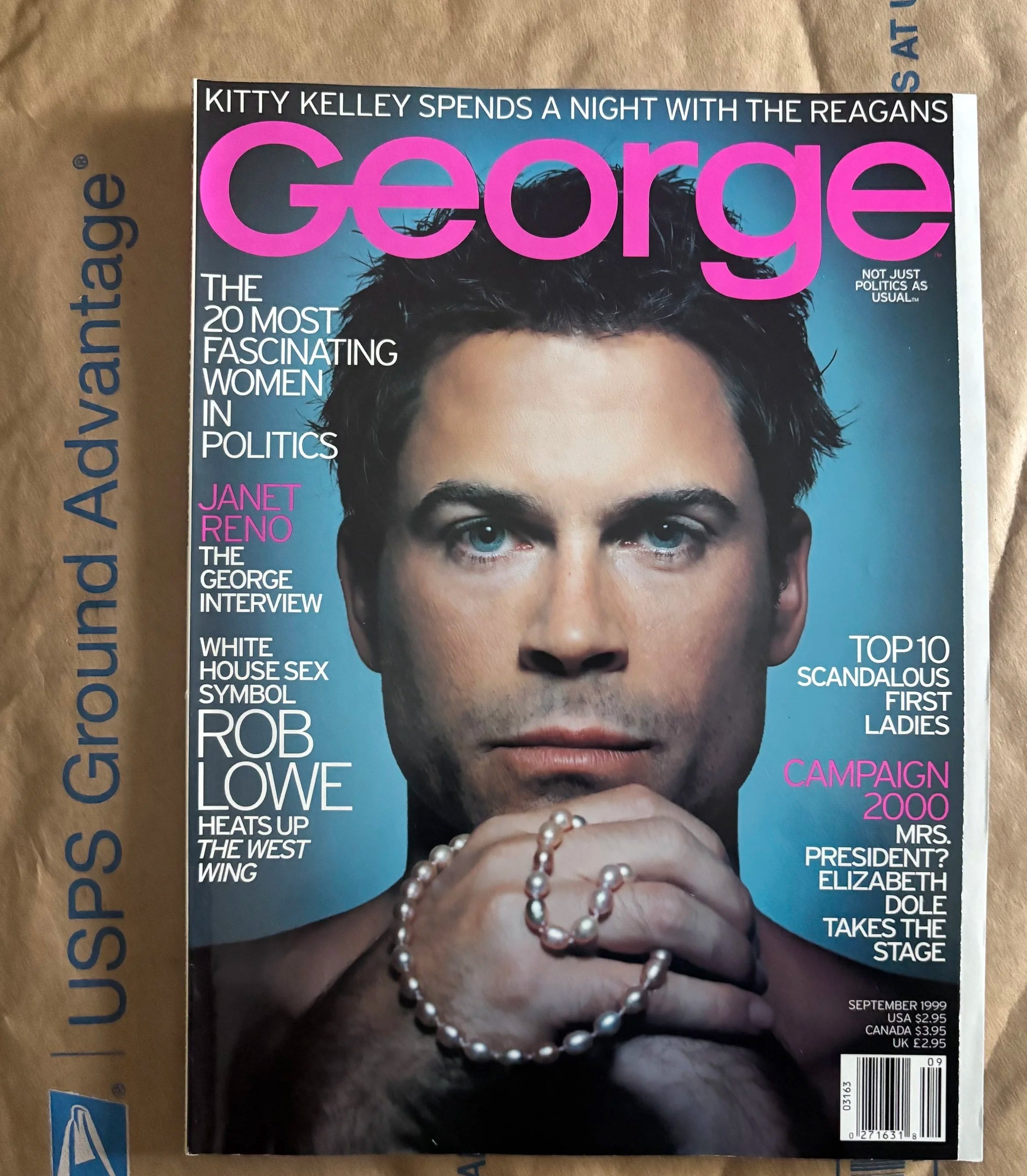
While scrolling through listings on Google Shopping like a slightly frenzied cougar on Tinder, I landed on a September 1999 issue with Rob Lowe on the cover.
If you think this was a shallow decision based purely on attraction, you’d be wrong…kind of.
Years earlier, I had devoured Lowe’s memoir, Stories I Only Tell My Friends. In it, he describes playing Sam Seaborn on The West Wing as the role of a lifetime and writes about how much he loved his character.
I like Rob.
I love The West Wing.
And 1999 happened to be one of the better years of my life.
That felt like reason enough.
I hit “buy,” and within days the magazine showed up at my door.
I opened the package carefully—almost reverently—as if the actual ashes of John might somehow be inside.
The moment I slid the magazine out, I knew I had made the right call.
It was pristine.
Not “good condition for 25 years old” pristine—actually pristine. As if I had just walked into a Borders Books in a mall somewhere in 1999 and pulled it straight off the rack.
I began paging through it, waves upon waves of nostalgia hitting me at a dizzying pace.
At first, I was mostly looking at the ads—because who wouldn’t? Magazine ads of the ’90s were the center of American culture. They were the OG influencers.
But in the case of George, there were only a select few who could actually afford what the ads were peddling—Prada, Chanel, Fendi.
For those of us on a budget, we emulated the look with Gap basics and ready-to-wear Calvin Klein, with a bit of J.Crew thrown in.
We were far removed from the excess of the ’80s and were enjoying a decade defined by minimalism. A simple pair of khakis and a crisp white button-down were always met with a compliment.
I continued paging through the ad-heavy issue—Lincoln. Acura. And, poof, surprisingly, Saturn.
Then I went back to the beginning to read what I assumed would be John’s letter from the editor.
To my surprise—and sorrow—it wasn’t written by John, but by his staff. My first thought was immediate: Oh damn, did I buy a bum issue?
But reading deeper, I realized it was actually the best issue I could have wished for. It was the last issue John worked on before his fatal accident.
“Many of you have asked us how we plan to pay tribute to John in our pages. The answer is we’ve left this issue of George as it was before John’s death because it was the last one he edited.”
Funny how you can feel so much sadness for a person you didn’t even know—and who has been gone for more than 25 years.
Suddenly I was transported back to the week John, Carolyn, and her sister, Lauren Bessette, died.
Their plane went down on a Friday night—July 16, 1999—so it missed the morning weekday commute news cycle. At the time, I was working in a salon in Beverly Hills, California, so there was a little chatter about it on Saturday. It wasn’t until the following Thursday that the wreckage confirmed what everyone had begun to fear.
He was gone.
The air felt heavy in Los Angeles that week, but not nearly as heavy as it must have been in New York and Washington, D.C.
Not only had America lost another Kennedy, but one that many secretly hoped would ditch his magazine and run for a soon-to-be-vacated Senate seat—the very seat that Hillary Clinton won in 2000.
We all had big aspirations for John.
He was the last visible echo of his father, John F. Kennedy—and everything that name had come to represent: youth, public service, and a certain American optimism that felt almost cinematic.
Two weeks following the crash, Daryl Hannah’s horse trainer came into my salon. Her name was Trina.
I knew she worked for Daryl because she loved talking about her job taking care of the horses, and she always spoke highly of her.
As I was washing her hair, making small talk, I suddenly blurted out:
“How’s Daryl doing with John’s death?” As if both of them were my close personal friends.
Trina didn’t seem to find the question out of line. In fact, she welcomed it. She thanked me for asking and said quietly, “She’s not doing well.
I wasn’t that familiar with their past relationship—I just knew they had been an item. Daryl and John had started dating in 1988. I was twelve then, far more interested in the Coreys and River Phoenix than in the romantic lives of Kennedys. But for some reason, I felt compelled to experience the loss through Daryl’s heartbreak.
Fast forward to 2026 and we’re all a bit taken aback by the show’s portrayal of Daryl. Like, they did her real dirty. The show portrays her as a clingy, clueless woman. And perhaps her true free-spirited nature made her appear more eccentric to people outside her orbit.
But one has to wonder what the director’s notes said.
Be breathy. Be needy. Be a little unhinged.
Someone owes that poor woman an apology. And maybe give her a horse, too.
So beyond the great soundtrack, the clothes, the pre-9/11 New York backdrop, and the beautiful actors playing John and Carolyn, why does this show, set in the ’90s, feel so comforting for so many of us right now?
Maybe because we yearn for a time when things felt slower.
And, well… simpler.
No two-factor authentication codes arriving every five seconds.
No walk-through metal detectors at stadiums.
No algorithm deciding what we should care about.
No phones held up at every moment, ready to capture someone at their worst.
I always thought the ’80s were the best decade—the glam rock music, the Spicoli-esque movies, the sheer spectacle of it all. But watching this show has given me a new appreciation for how quietly cool the ’90s really were. The music we listened to, the clothes we wore, the magazines we read—all of it shaping us in ways that felt effortless at the time. Looking back now, it feels like we were living through something far more special than we ever realized.